Modern IT landscapes increasingly rely on distributed network solutions such as software-defined wide area networks (SD-WAN), content delivery networks (CDN), and secure access service edge (SASE).
They offer unmatched performance, scalability, and flexibility, enabling businesses to operate smoothly across different geographical locations.
Managing these intricate networks poses a distinct set of obstacles for network administrators in overseeing, resolving issues, and guaranteeing peak performance.
Network administrators must also tackle critical issues such as enforcing uniform network policies, optimizing bandwidth utilization, and safeguarding distributed environments from threats.
Additionally, managing distributed networks has become more complex due to the increasing popularity of remote work and cloud services.
In this blog, we will delve into the complexities of distributed networks, examine the challenges faced by network administrators, and explore how OpManager Plus can help you overcome these hurdles and achieve optimal network performance.
We will explore the functionalities of OpManager Plus and how it can streamline the administration of decentralized networks for your IT.for your IT.
What is a distributed network?
A distributed network is a network architecture where network components and resources are distributed across different physical locations, interconnected to form a cohesive network.
Imagine a retail store chain: A large retail chain with stores in different cities is a distributed network. Each store has its own inventory, sales, and customer data. However, they are connected through a central system that allows them to share information, track inventory, and coordinate sales promotions.
Distributed network management hurdles
Distributed networks bring about different challenges when it comes to controlling the flow of data between various network locations.
Traditional monitoring tools, which are specifically created for centralized networks, frequently do not meet the requirements in these types of environments. Network administrators encounter various difficulties when it comes to overseeing distributed networks, including;
Device discovery: The distributed nature of network devices across multiple locations complicates the task of network monitoring and management for administrators.
Network logs: Maintaining accurate and up-to-date network documentation for devices spread across multiple network sites is a complex task.
Visualization: Obtaining a comprehensive view of a distributed network’s infrastructure, including detailed insights into network devices, can be challenging.
Scalability: As distributed networks grow in scale and complexity, traditional network monitoring tools may become insufficient.
Managing alerts: Effectively managing and responding to alerts generated from various devices across different locations requires a robust and efficient network management system.
Efficiently Monitor Distributed Networks with OpManager Plus
Tracking all end devices across multiple network sites is difficult when monitoring distributed networks. OpManager Plus is a full network monitoring solution created to tackle these difficulties. Here’s how OpManager Plus can help:
Automating documentation and discovery: OpManager Plus automates the process of discovering new network devices and updating network documentation, reducing manual effort and minimizing human error.

Vendor-agnostic monitoring tool: OpManager Plus can monitor a wide range of network devices from different vendors, preventing vendor lock-in and ensuring comprehensive network visibility.
Centralized monitoring and management of devices across various locations: OpManager Plus enables unified network management by providing a unified platform for monitoring and managing devices across diverse locations. Its user-friendly dashboards offer valuable insights into network performance, facilitating efficient troubleshooting and issue resolution.

Preventing tool sprawl: Unlike other network monitoring solutions that require multiple tools to monitor performance, bandwidth, configurations, IP addresses, switch ports, firewalls, and applications, OpManager Plus provides a unified platform for comprehensive network management.
OpManager Plus offers a centralized network management platform, consolidating essential tools for monitoring, troubleshooting, and optimizing network performance. OpManager Plus eliminates the need for multiple specialized tools, preventing tool sprawl and simplifying network management.
Agent-based and agentless monitoring: OpManager Plus combines the advantages of agent-based and agentless monitoring to provide a comprehensive and efficient approach to managing distributed networks. This hybrid approach combines the best of both worlds, offering the detailed insights of agent-based monitoring and the broad coverage of agentless monitoring.
Enable site-level, full stack visibility: Obtain detailed visibility into the performance and health of individual sites within your distributed network, enabling proactive troubleshooting and optimization. Full stack visibility enables you to monitor and manage all aspects of your network, from the underlying hardware infrastructure to the applications running on top of it.
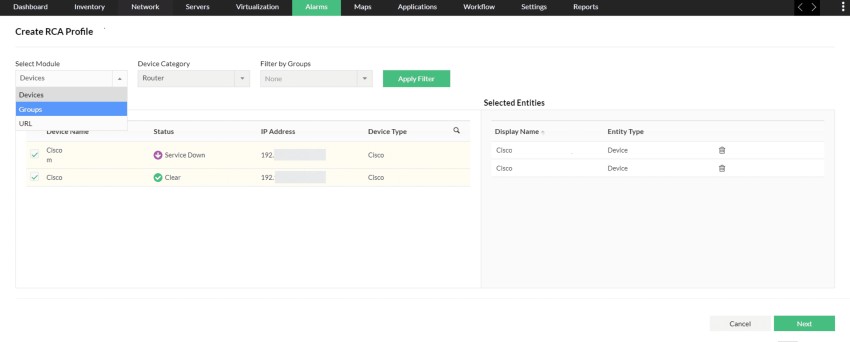
Root cause analysis and proactive monitoring: By leveraging Root Cause Analysis, OpManager Plus empowers network administrators to proactively identify and resolve network issues, minimizing downtime and optimizing network performance.
Reports catering to the whole stack: Create detailed, customizable reports that provide insights into network performance, application health, bandwidth usage, and other critical aspects of your network infrastructure. These reports offer a comprehensive perspective on network performance and can be customized to fulfill specific monitoring needs.

Cost-effective solution: OpManager Plus offers a cost-effective and efficient solution for network management, eliminating the need for multiple specialized tools and reducing operational costs.
By adopting a distributed network approach and utilizing a powerful network management solution like OpManager Plus, businesses can unlock the full potential of their IT infrastructure, achieving increased scalability, flexibility, and reliability.
Ready to master distributed network management? Take the first step towards optimizing your network performance and reliability. Try OpManager Plus today! Leverage our 30-day free trial or book a personalized demo with our product experts to experience the power of OpManager Plus firsthand.
Author Name: Sandhya Saravanan
About the Author: Sandhya Saravanan is a Product Marketer at ManageEngine. She creates user-friendly content that drives awareness around advanced network monitoring, observability, and AIOps. Beyond work, she’s an art enthusiast and volunteers at a non-governmental organization.
Related Posts
- Difference Between Routers and Switches in TCP/IP Networks
- 11 Different Types of IP Addresses Used in Computer Networks
- Compare and Contrast Network Topologies (Star, Mesh, Bus, Hybrid etc)
- 11 Networking Companies Like Cisco (Competitors)
- What is a Wildcard Mask – All About Wildcard Masks Used in Networking